

The Implications of Noah's Ark
The implications of finding the remains of Noah’s Ark are staggering.
Former editor of National Geographic Magazine, Gilbert H. Grosvenor once said, “If the ark of Noah is ever found, it will be the greatest archaeological discovery in history and the greatest event since the Resurrection of Christ; and it will alter all the currents of scientific thought.”
That is an amazing admission from the editor of a magazine that has worked tirelessly to promote the co-dependent ideas of evolution and billions of years of time. Why would he suggest that the discovery of the ark would “alter all the currents of scientific thought”?
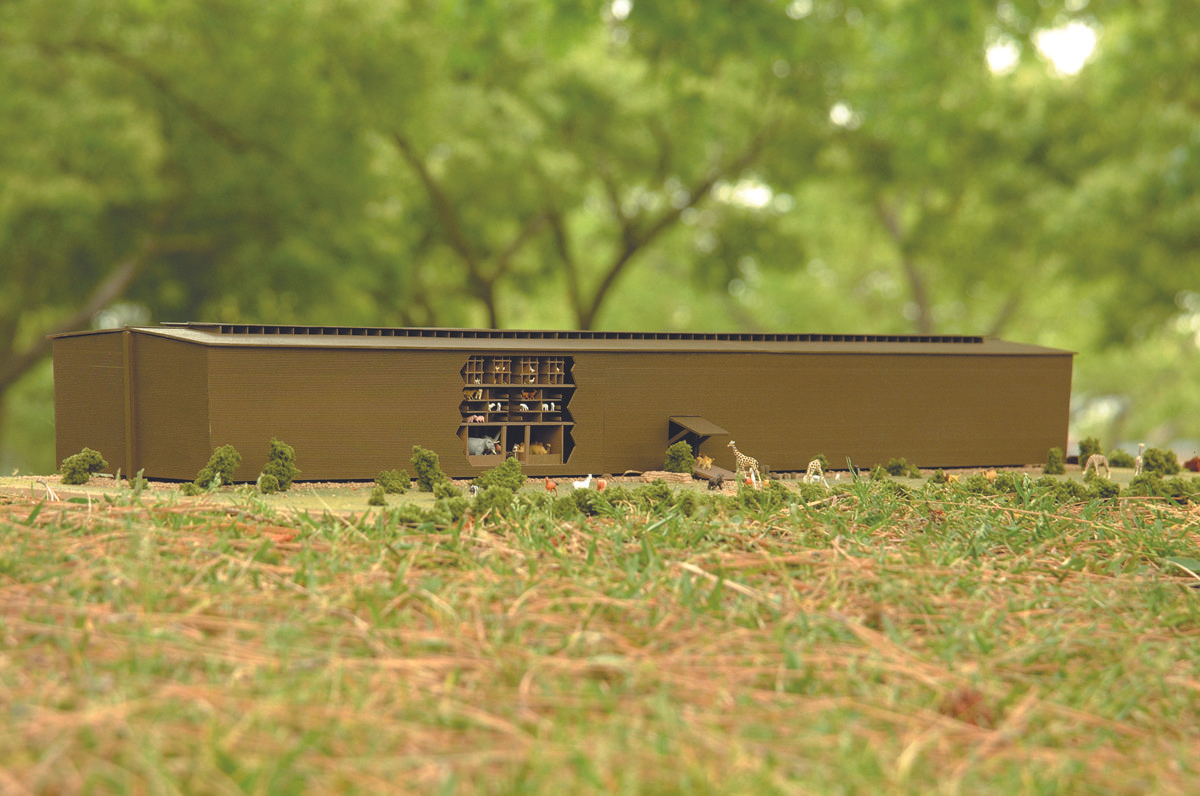
Model of Noah’s Ark created at “N-scale.” Photo by Barrie Schwortz
If the ark is found in the upper reaches of a 17,000 foot mountain, then the primary implication is that there was once a global flood. The ark by calculation of its displacement, utilized roughly 25,000 tons of lumber. To propose that it arrived on the top of a mountain in any manner other than transportation by water is untenable. Water does not rise in a bubble; it rises and seeks its own level. Gilbert Grosvenor understood that a huge ship on the top of a high mountain would clearly indicate a global flood.
For an ark to have been built that would not only withstand the ravages of a global flood, but could contain representative specimens of all the air-breathing animals of the world, it would require advanced certain knowledge of the coming of such a flood. The building of the ark likely required hundreds of years [see book chapter on “the Biblical Account of the Flood”].
Only God, the Creator, could have had such certain knowledge to pass along to Noah. Consequently, the implications of finding a huge wooden ship high on Mt. Ararat include the fact that there is a God who speaks to mankind and who desires to offer him salvation.
Furthermore, it would quickly become abundantly clear that all our prior understanding of geology, which ignored or denied the occurrence of a global flood, is bereft of meaning. No proper understanding of geology or even archaeology could occur without a prior understanding of the occurrence of a global flood. The devastation caused by even a mild tsunami can be catastrophic—a global flood would alter every geological feature on earth. Mountain chains and Grand Canyons would have been formed cataclysmically in very short periods of time rather than slowly over millions of years of time.
Any evolutionary interpretation of the fossil record would have to be scrapped. Indeed, it would appear that the entire fossil record is a record of that one cataclysmic event—the flood of Noah. In fact, all the coal deposits, rather than accumulating slowly over eons of time, would have been cataclysmically deposited by the flood. Thus, Grosvenor’s implicit understanding that all currents of “scientific” thought would be altered by the discovery of the ark. [see book chapters on “the Myth of the Ice Age,” and “Archaeological Anomalies.”]
The Biblical account of the Noahic Flood would regain its rightful place in both society and the church as history. It is remarkable to me that “history” classes at both the high school and university levels often teach about “Ice Ages” when there is not one shred of recorded evidence of anything akin to such a thing, but completely ignore the history of a global flood when the written and geological evidence for same is overwhelming. II Thessalonians 2: 10-11 declares that “[Men] perish because they refused to love the truth and so be saved. For this reason God sends them a powerful delusion so that they will believe the lie . . . .” [NIV]
The continued existence of the Ark
There is no biblical requirement that Noah’s Ark has survived until the modern era, though there may be some tantalizing hints. For example, in Genesis 6:14, God required that Noah coat the ark “with pitch both inside and out.” “Pitch” on the outside of the ark would have been effective in waterproofing it, but the order to cover it with pitch on the inside as well might be seen as an aide in preserving it for just such a time as this.
The Biblical account of the flood claims that the ark came to rest on the “mountains of Ararat.” Though some scholars have claimed that the “mountains of Ararat” could include a large region and other possible candidates for the proper mountain, the current Mt. Ararat in eastern Turkey certainly qualifies as being in the proper area. Indeed, physically speaking it must be considered the leading candidate. According to Genesis, after the ark came to rest and the waters continued to subside, it was two-and-a-half months before any other mountain peaks in the area could be observed by Noah and his family. That would be true of virtually none of the other candidates suggested for “Ararat” by scholars. Mt. Ararat in eastern Turkey is a free-standing volcanic mountain almost 17,000 feet high. Lesser Ararat, a smaller peak to the southeast is roughly 14,000 feet high and it is the only other peak in the immediate vicinity. Mt. Ararat in eastern Turkey also happens to be a peak that is glaciered over year round and could potentially keep the ark buried and hidden.
If studied at face value, the eyewitness accounts would essentially lead to the current Mt. Ararat and no other. Some stories are undoubtedly apocryphal, some anecdotal, some invented for publicity-sake and, as with any eye-witness accounts, all must be examined with caution. Nevertheless, there is no other mountain anywhere in the world that has such a wealth of eyewitness accounts of the remains of Noah’s Ark that are not easily discounted. One such account is that of Ed Davis. Ed was stationed in Turkey during WWII with the 363rd Army Corps of Engineers building supply roads into Russia. A young man who had been hired to drive trucks for the army was named Badi Abas. One day, according to Ed, Badi pointed to a distant, snow-covered peak and said, “Agri Dagh, my home.” “Agri Dagh” is said to mean “mountain of pain,” or “painful mountain,” and it is the name used of Mt. Ararat in eastern Turkey. Any researchers using the Ed Davis account to try and locate the mountain in his story must take into account that the shepherds called the mountain “Agri Dagh.” One day, Badi’s grandfather came to the base to tell Badi that the ark was now visible and they were going to go there. Ed was given a leave of absence by his commanding officer, and having done favors for Abas’ village, was permitted to go with them. In a small village in the foothills of Ararat, they showed him artifacts that had come from the ark when it broke open: oil lamps, tools, clay pots. One cage door he was shown (estimated by Ed to be about 30” x 40”) seemed to have been made of woven branches, but now appeared petrified.
On their climb they passed by some notable landmarks named by the shepherds: “Jacob’s Tomb,” and “Jacob’s Well.”
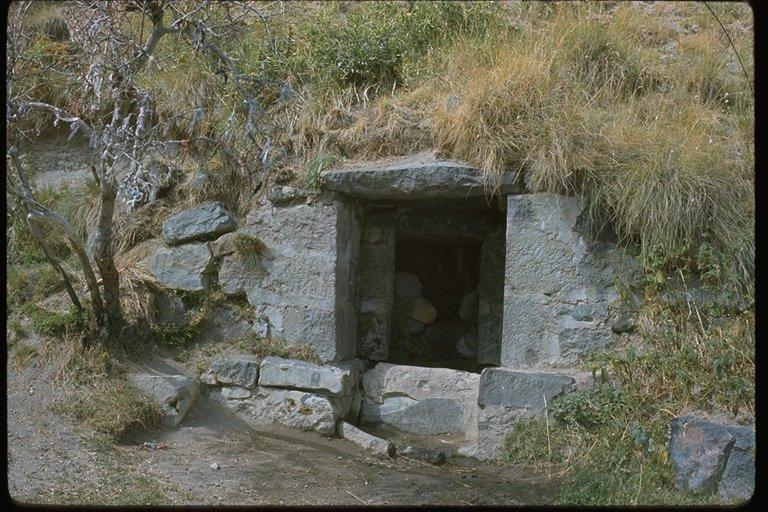
In support of Ed’s story and authenticity, both of those important locations exist in the Ahora Gorge on Mt. Ararat in eastern Turkey, but they have been identified in no other place. Furthermore, on one of the nights, they stayed in a very large cave that was identified as the hide-out of Lawrence of Arabia. Such a cave is also known in the Ahora Gorge on Mt. Ararat.
Photograph of cave of “Lawrence” in Ahora Gorge—upper right of photo.
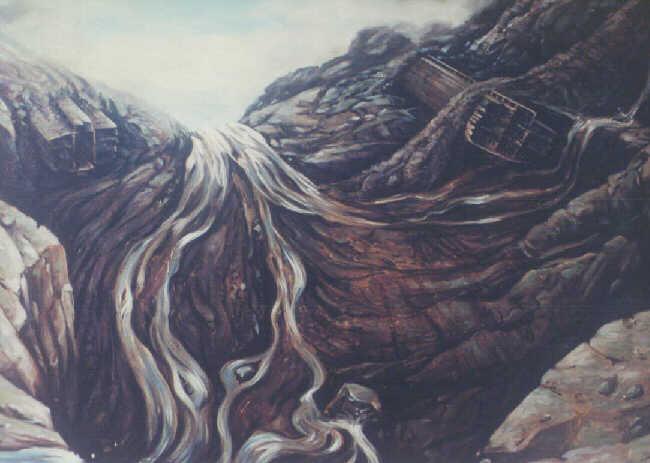
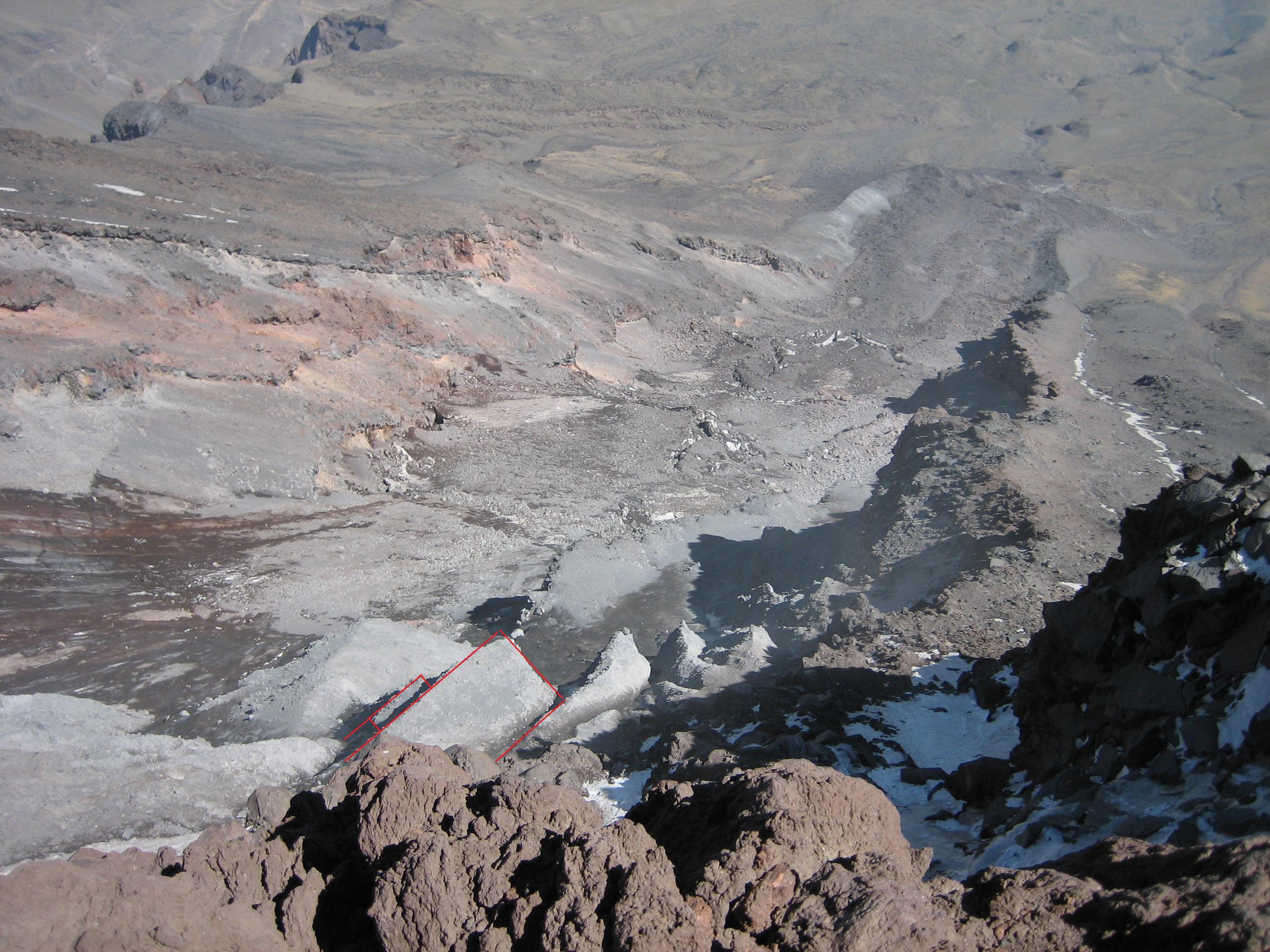
After three days of climbing they were able to look down into a horseshoe-shaped valley or crevasse and see two large pieces of the ark. Ed described it as “a huge, rectangular, man-made structure partly covered by a talas of ice and rock, lying on its side. At least a hundred feet are clearly visible. I can even see inside of it, into the end where it’s been broken off, timbers are sticking out, kind of twisted and gnarled, water’s cascading out from under it.” Ed could see three levels in the ark and a second large portion of the ark further down the mountain.
Elfred Lee’s depiction of Ed Davis’ eyewitness description of the Ark.
The shepherds told Ed that there were cages of all sizes inside the ark, and that in the upper floor there were forty-eight rooms for Noah and his family. In the morning, when they were going to use ropes to climb down to the ark, the ark was covered by a fresh snow storm and invisible. The climb back down the mountain took five days.
One other account that bears mentioning, is the account of Vince Wills. Vince was stationed in Greece during WWII and he recalled that one day, several pilots were examining photos that had been taken of a huge wooden ship jutting from the ice, high on Mt. Ararat. When it became obvious to some that they were looking at the remains of Noah’s Ark, Vince and his pilot friend wanted to know specifically the route they needed to fly in order to see it for themselves. The following day, they flew over the Ahora Gorge on Mt. Ararat in the specific route and orientation described to them and they saw the ark for themselves.
Vince was adamant that what he saw was not a rock or cave or some other type of anomaly—he said that it was a huge wooden ship, that there was damage to one side and he could see into the interior. He was so convinced of what he had seen, that he told my friend and climbing partner, Richard Bright, “I would stake my salvation on the fact that I saw Noah’s Ark.” Vince never wavered in his conviction nor his depiction of what he had seen to the day he died. [for more information on the history of the search for Noah’s Ark, see the website: noahsarksearch.com, as well as the pertinent chapters in my book.]

David Larsen
David Larsen has a passion for the truth of Creation, both on the scientific level and in the Scriptures. His desire is to see Christians return to a foundational belief in the complete veracity and authority of the Bible, and to see the stronghold of evolutionary teachings over America’s schools and colleges broken.
David's quest has led him to make nine trips—and counting—to eastern Turkey, two trips to Armenia, and he has climbed Mt. Ararat five times in an effort to verify the remains of Noah’s Ark. He has authored several articles for Creation journals, as well as his recently released book, Dinosaurs on the Ark.
God Created Ministries - David Larsen. All Rights Reserved.